
The short answer: quartz vs quartzite side by side
If you only have a minute, this table covers it. The sections below explain each row and give you the details you need before you decide.
| Feature | Quartz | Quartzite |
|---|---|---|
| What it is | Engineered stone made in a factory | Natural rock, quarried and cut into slabs |
| Made of | About 90 to 94 percent crushed quartz, the rest resin and pigment | More than 90 percent quartz grains, fused by heat and pressure |
| Look | Even and repeatable, in almost any colour | One of a kind. Mostly pale neutrals, with blues, greens, gold and rust in rarer stones |
| Hardness | About 7 on the Mohs scale | About 7, sometimes a little higher |
| Heat | The resin can scorch or crack under a very hot pan | Handles heat far better |
| Sun and outdoors | Not a good choice outdoors, it can fade or warp | Suited to outdoor use |
| Stains and sealing | Non-porous, no sealing needed | Porous, so it needs sealing once or twice a year |
| Indicative price in India | About ₹250 to ₹1,200 per sq ft | From about ₹400 per sq ft for common types, more for rare ones |
What is quartz?
Quartz countertops are made by mixing crushed natural quartz with polymer resin and pigment, pressing the mix into slabs and curing them. Roughly nine parts in ten are stone, and the rest is the glue and colour that holds it together. Because the recipe is controlled, the factory can make a slab in almost any shade, and every slab of a design looks the same as the last.
That sameness is the main reason people choose it. If you are fitting a long kitchen run and want the whole counter to match, or you want a plain white or a flat charcoal, quartz delivers it. It also has no pores, so wine, oil, turmeric and tea do not soak in, and you never have to seal it.
The weak spots come from the resin. A very hot pan put straight down can leave a mark or a crack, and long hours of strong sunlight can fade or warp the surface. Quartz is also a manufactured product, so what you see in the sample is exactly what you get, with none of the depth you see in real stone.
What is quartzite?
Quartzite starts life as sandstone, a rock made of sand grains. Over millions of years, heat and pressure deep in the earth squeeze those grains together until they fuse into one tight, dense rock. The result is mostly pure quartz, and it is the reason quartzite is hard and why some types are translucent enough to glow when light shines through them.
Nobody makes quartzite. It is cut from the ground in blocks, sliced into slabs and polished, so every slab has its own pattern. Colours and veining come from tiny amounts of other minerals. Iron gives the rust and gold tones, and others give soft greens and blues.
One thing to watch: some stones sold as quartzite are really softer marble or dolomite with a similar look. They etch and scratch far more easily. Ask the supplier to let you test an offcut. Real quartzite will scratch glass and will not be marked by a steel knife, and a drop of lemon juice should leave no dull spot. We are happy for you to do this with our slabs too.
How they look: the biggest difference you can see
Put a quartz slab next to a quartzite slab and the difference is obvious within seconds. Quartz looks designed, with clean veins and a pattern that repeats. Quartzite looks like it grew, with clouds, cracks, crystals and colour that shifts across the slab.
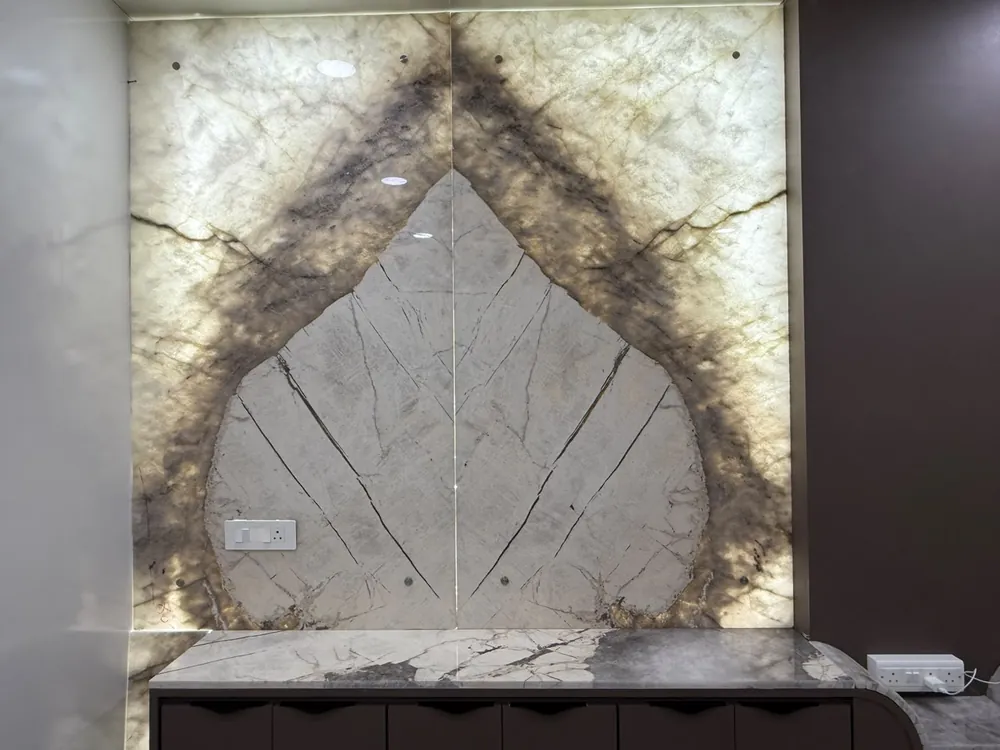
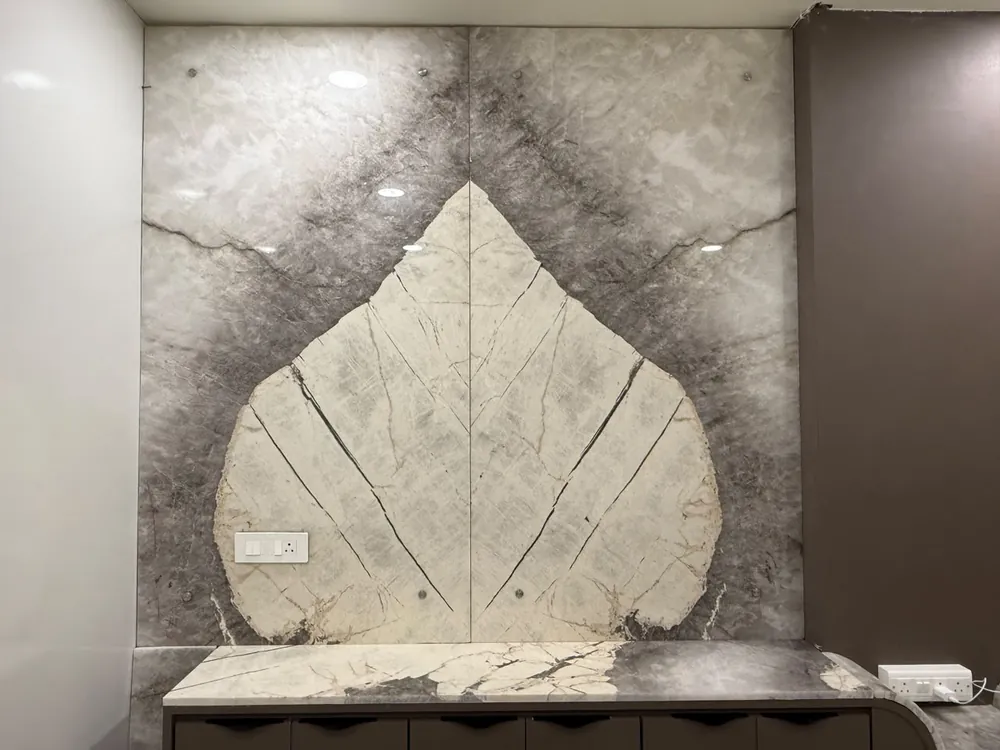
The wall below is Patagonia quartzite in an office. Two slabs have been book-matched, which means the second is a mirror of the first, so the leaf shape runs across both. With the lights off, the stone reads as a cool grey and cream. Switch on the light behind it and the same grey clouds turn warm and amber while the white glows. No quartz slab can do that, because the resin and pigment block the light.
Strength, heat and everyday use
On paper the two are close. Both sit at around 7 on the Mohs hardness scale, which is harder than a steel knife blade, so neither is easily scratched in normal kitchen use. Neither needs special treatment for chopping, but cut on a board anyway, because a blade will blunt on either.
Heat is where they part ways. Quartzite is natural stone and takes the heat of a pan without trouble, although we still suggest a trivet as a habit. Quartz is held together with resin, and resin does not like very high heat. If you cook with heavy pans straight from the flame, quartzite is the safer choice.
Weight is about the same, at roughly 20 kg or a little more per square foot of 20 mm slab, so do not pick one over the other for load reasons. Slab thickness matters more than the material.
Sunlight and outdoor use
This matters a lot in India, where the sun is strong for most of the year. Quartz is made with resin, and ultraviolet light can fade the colour and make the surface warp over time. Most quartz makers advise against using it outdoors or on a counter that sits in direct sun, so check the manufacturer's guidance before you commit.
Quartzite is natural stone that has spent millions of years in the open, so it is a good choice for outdoor kitchens, terraces, window ledges and sunlit counters. If you are planning an outdoor space, our guide to the best stone for outdoor paving and pool surrounds is coming soon.
Sealing and care
Quartz is the easy one. Wipe it with soap and water, avoid harsh chemicals and abrasive pads, and use a trivet. There is nothing to seal.
Quartzite is porous, even though it looks like glass. It needs a good stone sealer after installation and again once or twice a year, depending on the stone and how hard the surface is used. A simple test tells you when: put a few drops of water on the surface. If the stone darkens and the water soaks in within about ten minutes, it is time to reseal. Clean with a pH-neutral stone cleaner, and wipe up lemon, vinegar and wine quickly. Quartzite resists acid far better than marble, but it is not immune.
What do they cost in India?
These are indicative market ranges for material only, taken from published Indian price guides in 2025 and 2026. They are not an Avtikes price list. Prices are indicative only and can vary depending on the quality of the slabs, quantity, thickness, finish and the supplier. Cutting, edges, cut-outs, polishing and installation are extra, and installation alone often adds roughly ₹150 to ₹400 per sq ft.
| Material | Indicative price (₹ per sq ft) | What you typically get |
|---|---|---|
| Standard engineered quartz | 250 to 700 | Plain and simple patterns in entry and mid-range ranges |
| Premium quartz designs | 700 to 1,200 and above | Marble-look designs such as Calacatta and Carrara, and branded ranges |
| Common natural quartzite | About 400 to 700 | Popular types such as Taj Mahal, in standard thickness |
| Rare and translucent quartzite | Quote on request | Cristallo, Patagonia, Fuchsite and similar, priced slab by slab |
As a rule, ordinary quartz is often cheaper than ordinary quartzite, while premium quartz designs can cost as much as many quartzites. Rare, translucent quartzites sit at the top of the range, because good slabs are scarce and each one is chosen by hand. For slab prices, tell us the stone, quantity, thickness and finish and we will quote per sq ft.
Where each one works best
Choose quartz for busy family kitchens where you want a plain, matching surface and no upkeep, for vanity tops in bathrooms where you do not want to seal anything, and for projects where several slabs must look identical.
Choose quartzite for kitchen islands and counters where you cook hard, feature walls, backlit panels, bathrooms, statement flooring, outdoor kitchens, and any place where you want a surface nobody else has.
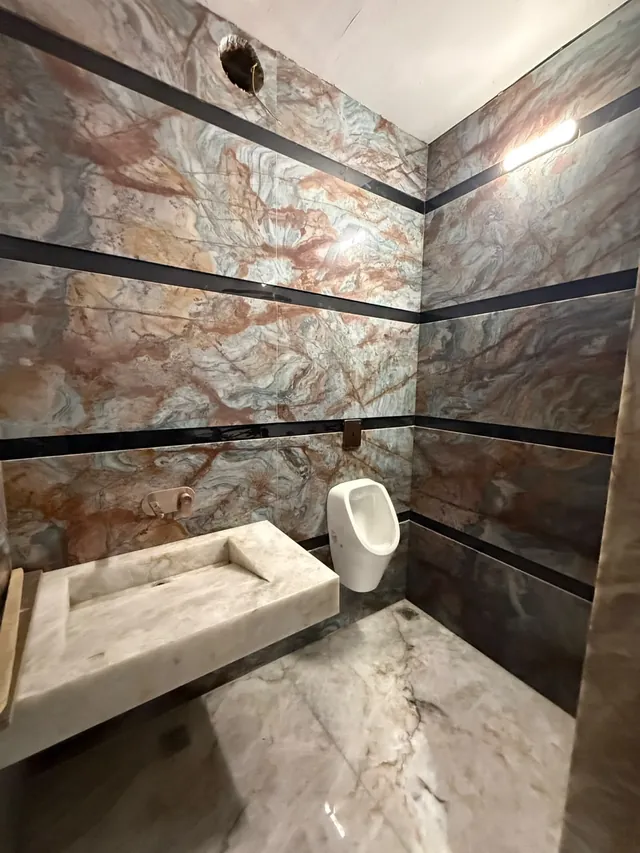
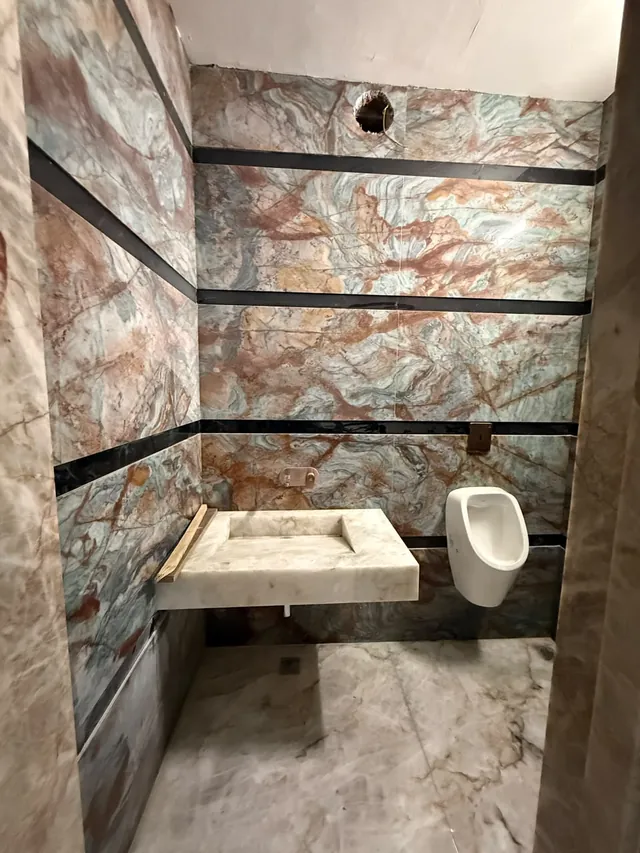
The bathroom below is a good example of how far quartzite can go. The walls are Fuchsite quartzite, in aqua and rust, banded with black. The washbasin is cut from Cristallo quartzite, and the floor is Cristallo as well. All of it is natural quartzite, and none of it repeats.
Taj Mahal, Patagonia, Cristallo and Fuchsite: the quartzites we supply
We supply four quartzites from India. Taj Mahal is a soft cream and beige with fine gold veining, and it is the safe, popular pick for kitchens. Patagonia has cream, grey and dark crystal clusters, and it is translucent. Cristallo is a white, glass-like quartzite made for backlit work. Fuchsite is aqua and turquoise with rust and gold veining, and every slab is a one-off. You can see photos of the slabs on our natural stone slabs page.
If you want a backlit surface, read our guide to how backlit stone works in a bathroom first. It explains what the stone and the lighting need.
How to choose between quartz and quartzite
- Do you cook a lot, with hot pans? Quartzite is safer.
- Do you want every slab to match? Quartz is more predictable. With quartzite, you pick the actual slab you like from photos.
- Will the surface sit in sun or outdoors? Choose quartzite.
- Are you happy to seal a surface once or twice a year? If not, choose quartz.
- Do you want a natural pattern or glow? Only quartzite can give you that.
- What is your budget? Ordinary quartz is usually the lower cost, and rare quartzite the higher. Ask for a quote on both.
Our own view is simple. If you want a worry-free, even surface for a hard-working kitchen, quartz is a sensible product. If you want something with character that lasts for decades and you can live with a little sealing, quartzite is the more rewarding stone. We only work in natural stone, so we are biased, but we would rather you chose the material that fits your home than the one we sell.
Get quartzite slabs or a made-to-order piece from Avtikes
We supply natural quartzite slabs across India and for export, and we carve basins, tubs and furniture from them in our Udaipur workshop. Send us the stone you like, the quantity, thickness and finish, and we will share photos of actual slabs and a clear quote per sq ft. See our natural stone slabs, or request a quote.